How Long Do Asphalt Shingles Last? The Real Numbers
A data-driven look at asphalt shingle lifespan by type, climate, and conditions — plus why your 30-year warranty probably won't get you 30 years.
Articles on this site may include sponsored content. If they do, it's labeled clearly — and it still has to answer a real homeowner question. Same bar as everything else here.
How Long Do Asphalt Shingles Last? The Real Numbers
If you’ve ever stood in a roofing supply yard staring at a package that says “30-Year Warranty,” you’re not alone in wondering the same thing: Does that mean I get 30 years?
Short answer: No. Not usually.
The longer answer — the one that matters when you’re budgeting for a roof replacement or wondering if yours is near the end — involves shingle type, climate, attic conditions, and a handful of things you can actually control. Here’s the real data on what asphalt shingles deliver in practice, not what the marketing promises.
What you actually get vs. what the warranty says
Let’s start with the most important number in this entire article: the gap between a warranty and real-world lifespan is usually 5–10 years.
A “30-year architectural shingle” realistically lasts about 25 years in average conditions. A 50-year luxury shingle might give you 35. The warranty is a legal document that covers manufacturing defects — not sun, wind, heat, or time.
Here’s the breakdown by shingle type, based on thousands of roofs observed across North America:
| Shingle type | Stated warranty | Typical real-world lifespan | Notes |
|---|---|---|---|
| Economy 3-tab | 15–20 years | 12–16 years | Being phased out; minimal asphalt coating |
| Standard 3-tab | 20–25 years | 18–22 years | Still common on budget builds through mid-2010s |
| Architectural (dimensional) | 25–30 years | 22–28 years | Most common residential shingle by far |
| Luxury/designer | 30–50 years | 25–35 years | Thicker mat, heavier coating, premium price |
The warranty structure matters too. Most function like this:
- Non-prorated period (first 5–10 years): Full material replacement if there’s a defect.
- Prorated period (year 10 onward): Manufacturer pays a shrinking percentage of material cost — often pennies on the dollar by year 20.
- Exclusions: Weather damage, installation error, and inadequate ventilation void coverage outright.
In practice, a homeowner filing a claim in year 18 on a 30-year warranty might get a check for $400 in material credit. That’s not a roof replacement. That’s a gesture.
Three climate factors that shorten — or extend — your roof’s life
Where you live is probably the single biggest factor in how long your shingles last. The same architectural shingle installed in Minneapolis, Phoenix, and Portland will die at three different ages.
Heat (southern climates)
Attic temperatures in the South routinely hit 140–160°F in summer. That heat bakes the asphalt from below, accelerating oxidation. The result: 3–5 years shaved off expected lifespan in states like Texas, Florida, Arizona, Georgia, and the Carolinas.
A well-ventilated attic in Atlanta might keep shingles alive 22 years. A poorly ventilated one in Phoenix? Fifteen, maybe sixteen.
Freeze-thaw cycling (northern climates)
In the Upper Midwest, Northeast, and mountain states, water seeps into micro-cracks, freezes overnight, expands, and wedges those cracks wider. Year after year. The result is 2–4 years shaved off expected lifespan — not as aggressive as heat, but steady and cumulative.
Temperature swings (the wild card)
The worst conditions for asphalt aren’t just hot or just cold — they’re both. Climates with 100°F summer days and sub-freezing winter nights (think Colorado, Utah, the high plains) cause the most thermal cycling stress. Shingles expand and contract daily for years. Sealant strips fail. Tabs curl. Cracks form. If you live in a swing climate, assume your roof lands at the low end of its range.
The single biggest factor you can control: attic ventilation
Here’s something most homeowners don’t know: heat kills shingles from below faster than the sun kills them from above.
A properly ventilated attic stays within 10–15°F of outside temperature. A poorly ventilated attic can hit 160°F on an 85°F day. That radiant heat cookes the underside of the decking, which transfers into the shingles, accelerating aging across the entire roof surface.
Proper balanced ventilation (soffit intake + ridge exhaust) adds 3–5 years to shingle life. It’s the highest-ROI intervention you can make, and it costs a fraction of a roof replacement.
Signs your attic is cooking your shingles:
- Summer attic temperature over 120°F (go check on a hot afternoon)
- No soffit vents, or soffit vents blocked by insulation
- Ridge vents that aren’t cut through the decking
- Ice dams in winter (poor ventilation + poor insulation)
If you’re replacing your roof in the next few years, spend the extra money on ventilation upgrades. The roof you put on now will last noticeably longer because the attic won’t be working against it.
The biggest mistake homeowners make
I see this pattern constantly: A homeowner with a 30-year warranty waits until year 30 to think about replacement. Then they’re shocked when the roofer says the decking is rotted, the shingles are disintegrating, and the bill is $25,000 instead of $14,000.
Replacing on a warranty timeline instead of on condition is the most expensive mistake in roofing.
Your shingles don’t care what the warranty says. They fail when they fail. If your architectural shingles are curling at year 18, they’re done — warranty be damned. Waiting 12 more years because “they’re supposed to last 30” is how you end up with water in your walls.
Replace when the roof tells you it’s time, not when a piece of paper says it should be.
How to read your roof’s age visually
Here’s a rough timeline of what to expect as asphalt shingles age:
| Age | What you’ll see | What it means |
|---|---|---|
| 0–5 years | Minor granule loss in gutters after installation | Normal settling, nothing to worry about |
| 6–12 years | Light granule shedding, slight color fade | Normal aging; keep gutters clean |
| 13–18 years | Curling tabs, bare spots on south/west faces, sealant failure | Mid-life; start planning for replacement |
| 19–25 years | Widespread cracking, lifted tabs, missing shingles after storms | Replacement zone; act within 1–2 years |
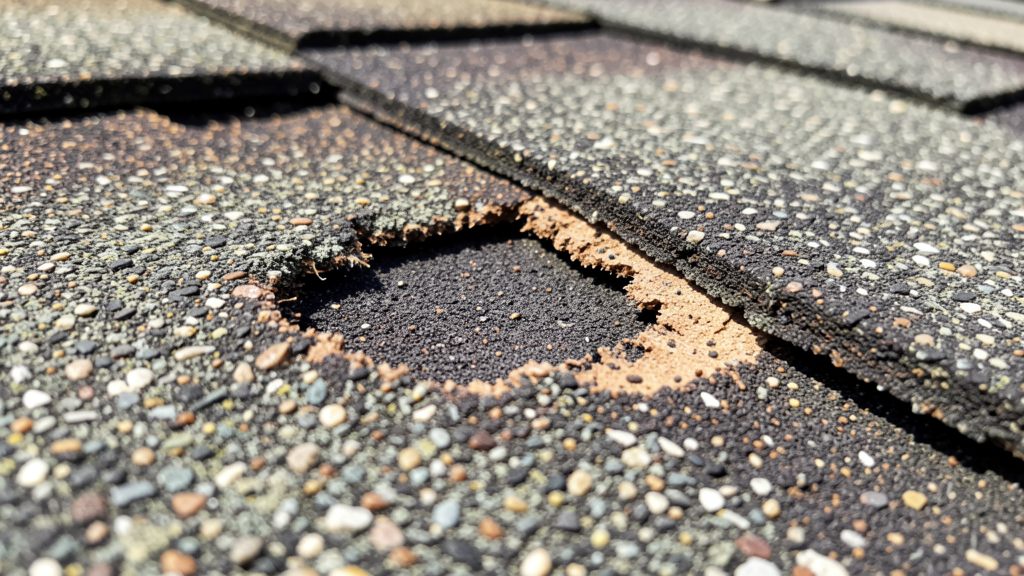
| 25+ years | Heavy granule loss, exposed asphalt mat, structural weakness | Critical; replace before water damage starts |
The key inflection point is year 15–18 for standard and early architectural shingles. If you inspect then and see moderate curling and scattered granule loss, you likely have 5–8 years left. But if you see widespread cracking and multiple missing shingles at year 15, the roof was under-ventilated, poorly installed, or both — and you’re closer to the end than you think.
Maintenance that buys real time
These are the only homeowner actions that measurably extend shingle life:
Clean gutters twice a year. Overflowing water saturates the decking edge and backs up under the first course of shingles. High impact, zero cost.
Remove moss immediately. Moss holds moisture against the granule surface. In freeze-thaw climates, moss-covered shingles fail 5–7 years early. Use zinc strips or copper sulfate — never a pressure washer, which blasts granules off.
Trim overhanging branches. Shade keeps the roof wet longer, and branches scraping in wind abrade granules. Drops the drying time dramatically.
Keep attic insulation clear of soffit vents. Baffles are cheap and prevent insulation from blocking intake airflow. If your soffits are buried, your ventilation is dead.
Annual walk-around inspection. After spring storms, walk the perimeter with binoculars. Look for lifted tabs, curled edges, and new bare patches. Fix individual shingles within weeks, not years — but only if the rest of the roof is sound.
When it’s time to stop maintaining and start replacing
There’s a point where further patching is throwing money away. Here’s how you know you’re there:
- Widespread curling or cupping. Once tabs lift, wind gets underneath and the problem accelerates. They won’t reseat.
- Granule loss in patches. Exposed asphalt is degrading every sunny day. The damage is cumulative and structural.
- Cracks across the field. Not one or two shingles — dozens. The asphalt mat has fatigued.
- Multiple repairs per year. If you’re fixing a few shingles every spring and fall, the roof is communicating. Listen.
Patching a roof that’s systematically failing is like changing a tire on a car with a cracked frame. It buys temporary relief, not longevity.
The cost of waiting too long
A planned replacement costs $10,000–$16,000 for an average architectural shingle roof. An emergency replacement — after leaks have damaged insulation, decking, drywall, and possibly wiring — runs $18,000–$30,000+.
The difference is usually 2–3 years of deferred action.
That’s the actual cost of “I’ll wait one more year.” Not saving money. Spending more.
What to do right now
If your roof is under 10 years old, keep maintaining and inspecting. If it’s 12–18 years old, have a professional inspection done — not a sales call, an inspection. If it’s 18+ years old and showing any of the failure signs above, start getting quotes.
Plan for replacement at year 20 on architectural shingles and year 15 on 3-tab. If you get 25 on architectural shingles in a moderate climate with good ventilation, that’s bonus time — enjoy it, but don’t count on 30 just because the warranty says so.
And when you do replace, invest in ventilation and ice-and-water shield. Not because the roofer upsold you. Because both of those things will make your next roof last longer than this one did.
Frequently asked questions
How long do 3-tab asphalt shingles actually last?
In real-world conditions, standard 3-tab shingles last 18–22 years. Economy 3-tab shingles (thinner, less asphalt) may only last 12–16 years. Most manufacturers have moved away from 3-tab production in favor of architectural shingles.
Do architectural shingles really last longer than 3-tab?
Yes. The multi-layer construction is thicker, more flexible, and more resistant to wind uplift. Under identical conditions, architectural shingles typically deliver 5–8 more years than 3-tab. The upgrade cost is usually worth it.
Should I replace my roof when the warranty expires?
No. Replace based on condition, not warranty timeline. A 30-year warranty doesn’t mean the shingles will function for 30 years. If your roof is showing curling or cracking at year 18, it’s time to start planning — regardless of what the warranty paperwork says.
Does attic ventilation really make a difference?
Yes — it’s the single biggest controllable factor. Proper soffit-to-ridge ventilation can add 3–5 years to shingle life by keeping attic temperatures within 10–15°F of outside air. A poorly ventilated attic accelerates asphalt oxidation from below, silently shortening your roof’s life.
How much does climate affect shingle lifespan?
Significantly. Hot southern climates (Texas, Florida, Arizona) shave 3–5 years off expected life. Freeze-thaw northern climates (Minnesota, New York, Colorado) shave 2–4 years. Moderate coastal climates (Pacific Northwest, Mid-Atlantic) get closest to the manufacturer’s ideal range.
Can I extend my roof’s life by repairing individual shingles?
Only if the roof is otherwise sound. If your roof is under 12 years old and has storm damage to a few shingles, repairs make sense. If it’s 18+ years old with widespread curling and cracking, repairs are a temporary patch on a roof that needs replacement.
What’s the most common mistake homeowners make with asphalt shingles?
Waiting until the warranty expires to plan for replacement. A roof that’s failing at year 20 doesn’t improve by year 25 — it gets worse, and the damage spreads to decking, insulation, and interior finishes. Plan for replacement at year 20 on architectural shingles. Anything beyond that is bonus.