Roof Overlay vs Replacement: Which Is Right for You?
Roof overlay saves $2,500–$5,000 upfront but costs more over time. Here's when it makes sense, when it doesn't, and how to decide without getting burned.
Articles on this site may include sponsored content. If they do, it's labeled clearly — and it still has to answer a real homeowner question. Same bar as everything else here.
Roof Overlay vs Replacement: Which Is Right for You?
I get asked this question more than any other. A homeowner gets an estimate for a full tear-off, sees the disposal line — usually $2,500 to $4,500 — and wonders: Can’t I just put new shingles on top?
Yes, you can. In most places, building codes allow it. But the real question isn’t can you? It’s should you?
If you’re staying in your home more than three years, the answer is almost certainly no. The upfront savings disappear fast when you account for shorter lifespan, voided warranties, hidden damage, and a future tear-off that costs twice as much. If you’re selling soon and the roof is in good shape, overlay can work.
Here’s the full breakdown — no sales pitch, no scare tactics, just the trade-offs and the math.
What each option actually involves
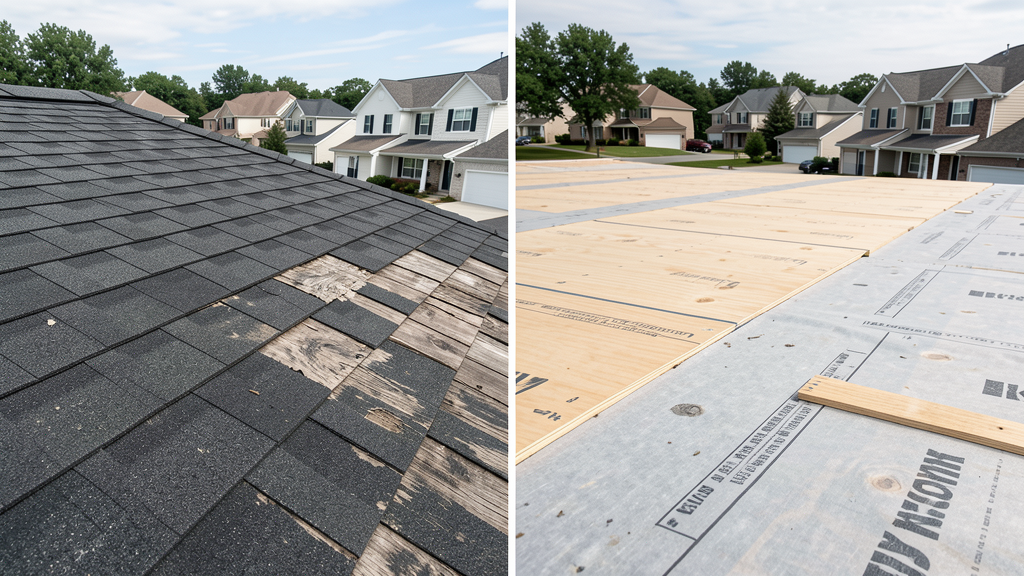
A roof overlay nails new shingles through the old ones. No tear-off, no deck inspection, no new underlayment, no new flashing. It’s faster and cheaper on day one.
A full tear-off strips everything down to the decking. The crew inspects every square foot, replaces any rotted wood, installs new underlayment, replaces all flashing around chimneys, vents, skylights, and valleys, then puts down fresh shingles on a clean, known-good surface.
The difference in labor: one extra day for tear-off, maybe two for a complex roof. The difference in cost: roughly $2,500 to $5,000 for a standard 2,000-square-foot home.
That’s what you’re weighing. A few thousand dollars today against everything else.
When an overlay is a legitimate option
I’m not going to tell you overlay is always wrong. It works under a narrow set of conditions. Here’s my checklist:
- One existing layer only. Most codes limit you to two total layers. If yours already has two, overlay is illegal.
- Shingles are flat and intact. No curling, buckling, or widespread cracking. An uneven old layer telegraphs through — you get a wavy roof.
- No history of leaks. Interior water stains mean compromised decking or underlayment. Overlay buries that problem instead of fixing it.
- Decking is known solid. You don’t actually know this without tear-off, but good attic access and zero moisture signs reduce the risk.
- Simple roof geometry. A basic gable or hip roof with one valley and a few vents is low-risk. Multiple valleys, dormers, skylights, and chimney crickets multiply failure points.
- Short ownership timeline. You’re selling within 2–3 years and need a functional, cosmetically acceptable roof for the sale.
If all six are true, overlay is defensible. If even one is false, strongly consider tear-off.
What the building code actually says
The International Residential Code (IRC) — which most U.S. jurisdictions follow — allows roof overlays under specific conditions. But local amendments vary wildly.
Here are the key code rules:
| Requirement | What the code says | The practical catch |
|---|---|---|
| Layer limit | Max 2 total layers | If there are already 2, tear-off is mandatory |
| Structural capacity | Roof must support the added weight | Older homes may need an engineer’s assessment |
| Nail penetration | Nails must penetrate decking by at least ¾” | Thick old shingles may prevent proper fastening |
| Flashing condition | Existing flashing must be intact | Most codes don’t require replacement — soft requirement |
| Deck condition | Deck must be sound | But you can’t inspect it without tear-off |
Some municipalities now require tear-off regardless of layer count. Others ban overlay in high-wind zones or historic districts entirely. A few — mostly in the Northeast — cap it at one total layer, making overlay impossible on any previously shingled roof.
Your contractor should know the local code cold. If they don’t mention it, that’s a red flag.
The hidden weight problem nobody talks about
Most homeowners don’t think about structural load. They should.
Standard architectural asphalt shingles weigh 230–280 pounds per square (100 square feet). An overlay adds a full second layer — you’re doubling the weight on your rafters and trusses.
| Shingle type | Single layer weight | Double layer weight | Structural impact |
|---|---|---|---|
| 3-tab asphalt | ~190–220 lbs/sq | ~380–440 lbs/sq | Significant increase |
| Architectural | ~230–280 lbs/sq | ~460–560 lbs/sq | Significant increase |
| Luxury/designer | ~300–400 lbs/sq | ~600–800 lbs/sq | Potentially critical |
Most homes built after 1985 can handle two layers. But older homes, manufactured homes, and homes with engineered trusses at their design limit? Doubling the roof weight — plus snow load in northern climates — can push the structure past safe tolerances.
And it’s not just total weight. It’s uneven weight. Old curled shingles under a new layer create pressure points that stress decking and framing in ways a single layer doesn’t. Over years, those stress points cause sagging, nail pops, and accelerated wear.
The real cost comparison
For a typical 2,000-square-foot home with architectural shingles:
| Cost item | Full tear-off replacement | Overlay | Difference |
|---|---|---|---|
| Tear-off and disposal | $2,500–$4,500 | $0 | You save $2,500–$4,500 |
| Decking repairs | $500–$2,000 (if needed) | $0–$500 (limited) | Variable |
| New underlayment | $600–$1,200 | $0 (old stays) | You save $600–$1,200 |
| New flashing | $600–$1,500 | $0 (old reused) | You save $600–$1,500 |
| Shingles and labor | $8,000–$14,000 | $8,000–$14,000 | Same |
| Total range | $12,200–$23,200 | $8,000–$15,000 | ~$3,000–$8,000 savings |
Upfront, overlay looks like a deal. But that’s not the full story. Here’s what happens over the life of the roof:
| Long-term factor | Tear-off replacement | Overlay |
|---|---|---|
| Expected lifespan (architectural) | 22–28 years | 12–18 years |
| Cost per year | $430–$850/year | $550–$1,260/year |
| Manufacturer warranty | Full coverage | Reduced or voided |
| Resale disclosure | Standard age disclosure | Must disclose extra layer |
| Future tear-off cost | Standard single-layer | Double-layer = 50–100% more |
The honest math: by year 12, the overlay roof is failing while the tear-off roof still has 10–16 years left. And when you do finally replace the overlay, you’re paying for a double-layer tear-off — the most expensive removal there is. That “savings” on day one turns into a loss by year 10.
What happens to your warranty
This surprises most homeowners. A new overlay does not mean a new manufacturer warranty. Usually it means no manufacturer warranty at all.
Major shingle manufacturers require installation over clean, solid decking with new underlayment per spec. Overlay fails those conditions every time.
| Warranty type | Tear-off replacement | Overlay |
|---|---|---|
| Full system warranty | Yes — all new components, installed per spec | Typically denied |
| Wind warranty | Full rated coverage (110–130 mph) | Reduced or eliminated |
| Algae resistance | Full coverage | May be voided |
| Workmanship (contractor) | 5–10 years typical | Often shorter or excluded |
| Transferability | Usually yes | Usually no |
Why do manufacturers refuse? Because they can’t control what’s underneath. If old shingles are curled, moisture is trapped, or the underlayment is degraded, the manufacturer has no way to guarantee the new shingles will perform. They’d rather deny coverage than eat the claims.
Some contractors offer their own workmanship warranty on overlays. That’s better than nothing, but it doesn’t cover material defects. If the shingles themselves fail, you’re relying on the contractor’s goodwill — not a binding manufacturer guarantee.
Practical problems with overlay
Beyond cost and warranty, overlay creates real-world issues:
Uneven appearance. Old shingles that aren’t perfectly flat show through the new layer. Your roof ends up wavy or lumpy, and you notice it every time you pull into the driveway.
Trapped heat. A double-layer roof runs 10–20°F hotter at deck level. That accelerated heat aging shortens the new shingles’ life from underneath.
Hidden deck damage. Without tear-off, rot, delamination, and insect damage stay invisible until ceiling stains or sagging reveal them — by then, the repair costs more.
Reused old flashing. Valleys, chimneys, and vents keep flashing that’s already 15–25 years old. That’s the weakest link in your roof, and overlay doesn’t touch it.
Raised roofline. A second layer lifts the roof edge ¼–½ inch, creating gaps at fascia boards, gutter alignment issues, and potential step-flashing problems at sidewalls.
Harder leak detection. When water gets in, a technician has to diagnose through two layers instead of one. More time, more cost.
The quick comparison
| Factor | Overlay | Full tear-off replacement |
|---|---|---|
| Upfront cost | $2,500–$5,000 less | Higher upfront |
| Lifespan | 12–18 years | 22–28 years |
| Cost per year | Higher over roof life | Lower over roof life |
| Deck inspection | None — problems stay hidden | Full inspection and repair |
| Underlayment | Reuses old | Brand new |
| Flashing | Reuses old | Fully replaced |
| Roof weight | Doubled | Standard design load |
| Manufacturer warranty | Usually voided | Full coverage |
| Appearance | May be uneven or wavy | Clean and uniform |
| Resale | Disclosed as negative | Neutral or positive |
| Future tear-off | Double-layer = 50–100% more | Standard single-layer |
| Best for | Selling soon, tight budget, sound roof | Staying in home, peace of mind |
When overlay is the right call
Fair is fair. Here are the scenarios where overlay makes real sense:
You’re selling within 18 months. The roof is functional but tired. An overlay gives you curb appeal at minimum cost, and you disclose the extra layer. The buyer knows what they’re getting.
It’s a detached garage or simple outbuilding. Single gable, no valleys, good ventilation, no leak history. Low risk, easy call.
The roof was exceptionally well maintained. Perfectly flat 12-year-old shingles, dry attic, excellent ventilation — you’re in the ~2% of roofs where overlay is a reasonable risk.
You need a temporary fix while waiting on insurance. Water protection now, full replacement later. Rare but legitimate.
In all these cases, overlay is a calculated compromise — not a shortcut.
The bottom line
Overlay is legal in most places, cheaper upfront, and faster. It also has a shorter lifespan, voids most manufacturer warranties, doubles roof weight, hides structural problems, and makes your eventual tear-off more expensive.
If you’re staying in your home more than three years, the math doesn’t work. You’re not saving money — you’re deferring a larger cost with interest.
If your contractor pushes overlay without walking through these trade-offs, ask why. Some prefer overlays because they’re faster and don’t expose decking repairs that slow the job. A contractor who recommends tear-off when it’s genuinely needed — even if it costs them the bid — is the one worth hiring.
Get itemized estimates for both options. Divide each by expected lifespan. Compare cost per year, not total cost. Inspect your attic for moisture first. And if you do overlay, disclose it when you sell — the next owner will find out anyway.
Need a ballpark for your full replacement? See our roof replacement cost guide. Not sure if your roof needs work at all? Start with 11 signs you need a new roof.
Frequently asked questions
Can you put a new roof over an old one?
Most U.S. jurisdictions allow one new layer over one existing layer. Some allow two. But a growing number of municipalities require tear-off regardless. The roof must be structurally capable of supporting the added weight, and nails must penetrate the decking by at least ¾ inch. Check local codes before making a decision.
How much money does a roof overlay save?
A roof overlay typically saves $2,500–$5,000 on a standard 2,000-square-foot home by eliminating tear-off, disposal, and flashing replacement costs. On larger or complex roofs, savings can reach $6,000–$8,000. But the reduced lifespan and higher per-year cost usually erase those savings within a decade.
Does a roof overlay void the manufacturer warranty?
In almost all cases, yes. Owens Corning, GAF, CertainTeed, and IKO require installation over clean, solid decking with new underlayment. Overlay doesn’t meet those conditions, so manufacturers either deny warranty coverage entirely or significantly reduce it. Some contractors offer their own workmanship warranty on overlays, but that does not replace the material warranty.
How long does a roof overlay last compared to a full replacement?
A roof overlay lasts 12–18 years with architectural shingles, versus 22–28 years for a full tear-off replacement. Trapped heat between layers accelerates asphalt degradation, old underlayment continues aging, and reused flashing tends to fail sooner — all of which shorten the overlay’s service life.
Is a roof overlay bad for your house?
Not inherently, but it carries real risks: doubled structural weight, hidden decking damage that goes undetected, voided manufacturer warranties, and a wavy appearance if the old layer is uneven. For most homeowners staying in their home long-term, the risks outweigh the upfront savings.
Can you overlay a roof that already has two layers?
No. Building codes universally prohibit three or more layers of shingles. If your roof already has two layers, tear-off is legally required. Any contractor who suggests adding a third layer is violating code and creating a liability for you.
Does a roof overlay affect resale value?
Yes, and typically negatively. Home inspectors note overlays and disclose layer counts in their reports. Buyers often negotiate price reductions or request additional disclosures when they learn a roof has an extra layer. A full replacement with clean documentation is a significantly stronger selling point.