Roof Maintenance Guide for Homeowners: Seasonal Checklist
Learn how to maintain your roof season by season: gutters, moss, flashing, ventilation, tree clearance, DIY limits, and when to call a roofer.
Articles on this site may include sponsored content. If they do, it's labeled clearly - and it still has to answer a real homeowner question. Same bar as everything else here.
Seasonal Roof Maintenance Checklist for Homeowners
Roof problems don’t announce themselves. They whisper. A lifted shingle here. A slow drip into the attic. A gutter that’s been overflowing behind the fascia board for three seasons. By the time you spot a water stain on your ceiling, the damage has been tunneling through your decking, insulation, and framing for months. You’re not looking at a quick fix. You’re looking at a project.
The truth is, most homeowners who get twenty-five to thirty years out of an asphalt shingle roof aren’t lucky. They’re methodical. They inspect twice a year, clean gutters on a schedule, and fix small problems before those problems invite rot, mold, and structural damage.
A well-maintained roof lasts five to ten years longer than a neglected one. With the average replacement running $12,000 to $25,000, that maintenance pays for itself many times over - especially if you already know the larger roof replacement process. Most homeowners end up spending $400 to $1,000 per year on upkeep and occasional pro visits - roughly a tenth of what it costs to react after failure.
This guide walks you through every season, every critical system (gutters, moss, flashing, ventilation, trees, attic health), and the honest split between what you can DIY and what needs a licensed roofing contractor. Let’s get into it.
Your seasonal maintenance cycle
Roofs live outside. They take whatever your climate throws at them, every day, all year. Maintenance works best when it follows the weather’s rhythm - addressing each season’s threat before it has time to do real damage.
| Season | Primary Threat | Core Tasks | Frequency |
|---|---|---|---|
| Spring | Winter debris, ice dam aftermath, clogged drainage | Clear debris; inspect for lifted or curled shingles; examine valleys and flashing; check gutters for freeze damage; look for early moss or algae bloom | Once, after last frost |
| Summer | UV degradation, heat-driven expansion, storm damage | Inspect after severe weather; check cracked caulk and sealants; confirm attic ventilation is moving air; trim overgrowth near roof lines | After each major storm; once mid-season |
| Fall | Leaf drop, blocked drainage, gutter overflow | Clean gutters thoroughly (twice); clear valleys; remove moss before dormancy; inspect flashing before freeze-thaw cycles; seal any gaps | Twice - early and late fall |
| Winter | Ice dams, snow load, freeze-thaw cycling | Monitor snow accumulation; watch for icicle patterns that signal heat loss; check attic for frost buildup; stay off the roof entirely | Weekly visual from ground |
Spring: Survey the damage winter left behind
Spring is assessment season. Winter is hard on a roof - freeze-thaw cycles expand every tiny crack, ice dams push water under shingles, and heavy snow load stresses the whole structure. Your job in spring is to find what broke before summer storms make it worse, using a simple roof damage checklist instead of guessing from the driveway.
Start with the gutters. Winter freeze-thaw is brutal on gutter seams. Trapped water expands, separates joints, and cracks sealant. Walk the perimeter and look for pulled nails, separated seams, sagging sections, and rust stains running down the fascia boards. If the paint is bubbling on your fascia, water has been sitting behind the gutter for a while.
Next, scan the roof surface. Asphalt shingles that were marginal going into winter often come out curled, cracked, or missing tabs. Pay special attention along the rake edges (the sloped sides of the roof) - that’s where wind gets underneath lifted shingles and peels them back in spring storms.
Check your valleys. Valleys are where two roof planes meet, and they channel more water than any other part of the roof. Even a small debris dam can force water sideways under the shingles. Look for exposed underlayment, lifted valley flashing, or rust on open metal valleys. If you see any of these, get a pro out before the spring rains hit.
Check pipe boots and chimney flashing. Rubber pipe boots get brittle in cold weather and crack at the flex point where they wrap around the vent pipe. A twelve-dollar pipe boot replacement beats a four-hundred-dollar ceiling repair every single time.
And keep an eye out for moss and algae. They wake up in spring too. If your north-facing slope or shaded sections are showing green patches or black streaks, make a mental note. You’ll treat those in the fall for best results - but knowing where they are now helps you track their spread.
Summer: Manage heat and storm aftermath
Summer looks like the easy season, but it’s not. UV radiation is actively degrading your asphalt shingles. Granule loss accelerates in the July and August heat. On a poorly ventilated roof, surface temperatures can hit 160 degrees Fahrenheit, cooking the underside of the shingles and causing them to blister and degrade from within.
Your primary summer job is watching what storms do. After any hail, straight-line wind event, or microburst, do a ground-level roof inspection. Look for missing shingles, torn ridge caps, dented vents, and impact marks on metal flashing. Hail damage often shows up as small, uniform divots on metal surfaces. If you see that pattern, document it with photos and check how homeowners insurance handles roof replacement before you call a contractor - the order matters for claims.
Don’t climb a wet roof after a storm. Wait at least forty-eight hours for everything to dry, then use binoculars or a zoom lens from the ground. A drone with a good camera is a smart buy for roof inspection. It keeps both feet on solid ground.
Mid-summer, add an attic ventilation check to your roof inspection checklist. Go up there on a hot afternoon. If the attic is over 120 degrees, your ventilation isn’t keeping up. That heat radiates down into your living space (driving up cooling costs) and bakes the underside of your roof deck, accelerating shingle wear. Check that ridge vents aren’t clogged with dust or debris, and confirm that soffit intake vents are open - not painted shut, not blocked by insulation, not filled with bird nests.
Fall: Button everything up before freeze-up
Fall is the most important maintenance season and the busiest. Leaves, pine needles, and twigs accumulate fast. If they freeze into your gutters or valleys, you’re setting yourself up for ice dams, water backup, and fascia rot that won’t show itself until spring.
Schedule gutter cleaning twice in the fall. Once after the early leaf drop (usually October), and again after the late-drop species have finished (November, depending on your region). Don’t wait until you see gutters overflowing. By the time water is spilling over the front edge, it’s also running behind the fascia and into your soffit vents. That hidden water does the most damage.
Fall is also the ideal time to treat moss and algae. The organisms are still metabolically active in the cooler weather, but the treatments stay effective longer because evaporation is slower. A fall treatment typically suppresses growth through the following growing season. Spring treatments work too, but summer sun burns them off quickly.
Inspect every piece of flashing and every caulked joint now. Any gap you seal in October will stay sealed through the winter. Any gap you miss will be twice as wide by February after freeze-thaw cycles have worked on it.
And check tree proximity. Branches that seemed safely distant in summer may be closer than you think once they’re fully leafed out. Fall, when the leaves are gone and the structure is visible, is your best window for identifying branches that need trimming before winter ice adds weight and turns them into roof-puncturing hazards.
Winter: Watch, wait, and don’t make it worse
Winter is not a maintenance season in most climates - it’s a monitoring season. There’s very little you should actually do to your roof between December and March, but there’s plenty you should watch.
Keep an eye on icicle formation. Small, scattered icicles are normal. Long, uniform icicles running the length of the eave indicate a heat-loss problem - warm air from your living space is melting snow on the roof, which refreezes at the cold edge. That’s an ice dam in the making. If you see water staining on your soffits or exterior walls below the icicle zone, the dam is already doing damage. Call a pro.
Snow removal is dangerous and rarely necessary on a properly built roof. The typical residential roof is engineered for twenty to thirty pounds per square foot of snow load. Wet, compacted snow at four inches deep weighs roughly that. Unless your roof was poorly framed, your region got record snowfall, or you see visible sagging, leave the snow alone. If you’re genuinely worried, hire an insured contractor with roof snow removal equipment. Do not climb onto a snowy roof with a shovel.
One thing you can safely do in winter: inspect your attic. If you see frost on the underside of the roof deck or on protruding nail points, it means warm, moist air from your living space is escaping into the attic and condensing on cold surfaces - one of several early roof leak warning signs worth taking seriously. That’s an air-sealing problem. Make a plan to address it in spring - seal ceiling penetrations, improve bathroom exhaust venting, and check that your attic insulation is properly installed.
Gutter care: why it’s the most important thing you do
Gutters are your roof’s drainage system, and a drainage system that doesn’t drain is worse than no drainage at all. When gutters clog, water overflows the back edge and runs directly into your fascia boards, soffit vents, and sometimes behind your siding. The rot starts small and stays completely hidden until the paint bubbles or the gutter pulls away from the house.
For most homes in temperate climates, gutters need cleaning at minimum twice per year - late spring and late fall. If you have deciduous trees overhanging your roof, plan on three to four cleanings. Pine needles are worse than broad leaves because they mat into a dense layer that standard gutter guards can’t always stop.
If you’re doing it yourself, use a stable ladder with standoff arms so you don’t dent the gutter or lean directly against it. Scoop debris into a bucket - don’t toss it onto the roof or into the garden. After the debris is out, flush each downspout with a garden hose. If water backs up at the downspout elbow, use a toilet auger or disassemble the elbow to clear it. Do not use compressed air. It can blow underground drain pipes apart.
Gutter guards reduce the frequency of cleaning but don’t eliminate it. They work well on simple roof shapes with moderate tree cover. Under heavy tree canopy, they shed most visible debris but still accumulate fine particles that need blowing or brushing off a few times a year.
The bottom line: A hundred and twenty bucks a year on gutter cleaning prevents eight hundred to three thousand dollars in fascia and soffit repairs. That’s a top-tier return on investment in home maintenance.
Moss and algae: how to handle both
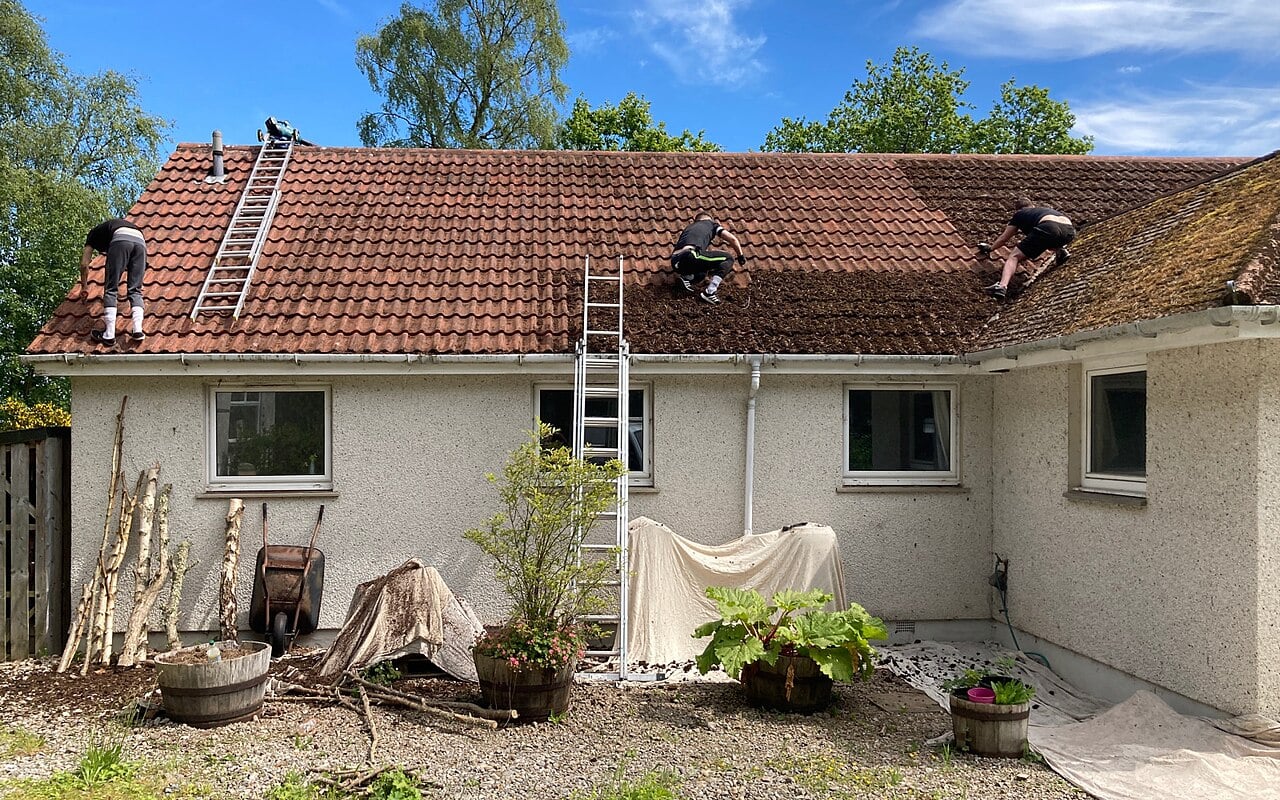
Moss and algae are not the same thing, and they don’t damage your roof the same way. Algae (the black streaks you see on north-facing slopes) is a cyanobacterium called Gloeocapsa magma that feeds on the limestone filler in asphalt shingles. It’s ugly, and it holds moisture against the shingle surface, but it doesn’t physically lift or separate shingles.
Moss is a different animal. It’s a root-based plant that wedges itself between shingle tabs, lifts them apart, and traps moisture against the roof deck underneath. Moss does real structural damage. If you have moss, deal with it promptly.
Moss removal
Do not pressure-wash moss off shingles. Pressure washing strips the protective granules off asphalt shingles and voids manufacturer warranties. The correct approach:
- Wait for a dry, overcast day - direct sun dries the chemicals too fast.
- Gently brush off loose moss with a soft-bristle broom, working from the ridge down.
- Apply a zinc or copper sulfate solution at label strength. Don’t double the concentration thinking it’ll work faster - it won’t, and it’ll damage your landscaping.
- Let it sit fifteen to twenty minutes, then rinse lightly with a garden hose.
- Dead moss will flake off naturally over the next two to three weeks as rain hits it.
Zinc strips installed at the ridge line prevent regrowth. Rainwater washes zinc ions down the slope, creating an environment moss can’t colonize. It’s a slow, preventive approach - great for keeping a clean roof clean, but no substitute for killing an existing infestation.
Algae removal
Algae responds to a fifty-fifty mix of household bleach and water, or a commercial sodium hypochlorite cleaner. Apply with a pump sprayer, wait fifteen minutes, rinse. Cover your plants and grass below the roofline - bleach will kill landscaping.
Never use undiluted bleach. Never mix bleach with ammonia or vinegar; both combinations produce toxic gases. If your roof is under warranty, check the manufacturer’s guidelines first. Some warranties restrict chemical treatments to specific approved solutions.
For steep roofs or heavy infestations, hire a pro. Roof washing contractors charge $300 to $600 for an average single-family home, and they carry liability insurance if something goes wrong. A pro also knows which cleaners are safe for your specific shingle type - not all roofs respond the same way to chemical treatments, and different types of roofing shingles tolerate cleaning differently.
Tree management: clearance, hazards, and storm risk
Trees are complicated for a roof. The right tree in the right place provides shade that reduces summer surface temperatures and can extend shingle life. The wrong tree, or the right tree in the wrong spot, drops debris, encourages moss, and turns into a two-thousand-pound projectile during a storm.
The safe clearance rule: no branches should touch or hang directly over the roof surface. Maintain at least six to ten feet of horizontal clearance from the roof edge. This prevents:
- Leaves and needles accumulating in valleys and gutters
- Branch abrasion wearing granules off shingles in wind
- Squirrel and rodent access to your roof - and from there, your attic
- Falling limb damage during ice or wind events
For tall canopy trees that overhang without touching, do an annual check for dead limbs, split trunks, or fungal growth at the base. A decayed tree can drop a hundred-pound limb without any warning at all. If the tree is on your property, hire a certified arborist for a hazard assessment. If it’s on your neighbor’s property, have the conversation before the next big storm, and document the hazard in writing.
In high-wind regions, thin the crown of overhanging trees to reduce wind resistance. Dense canopies catch wind like a sail. A properly thinned tree lets wind flow through instead of pushing against your roof.
And don’t ignore what’s happening at ground level. If a tree is tilting toward your house or its root system is heaving soil near your foundation, removal is often cheaper than the water intrusion and structural damage it will eventually cause.
Flashing inspection: where most leaks start
Flashing is the waterproofing at every seam, joint, and penetration on your roof. It’s also what homeowners look at the least - and where most leaks actually begin.
Your roof has several distinct flashing systems:
- Step flashing along walls and chimneys where roof planes meet vertical surfaces
- Valley flashing where two roof slopes intersect
- Drip edge at the rake and eave edges
- Pipe boots around plumbing vents
- Chimney cricket or saddle on the upslope side of wide chimneys
- Vent and skylight flashing kits sealed with caulk or tape
During your biannual inspections, check for:
- Rust on metal flashing, especially galvanized steel in coastal or snowy climates
- Lifted, curled, or detached flashing tabs
- Cracked or dried sealant at seams
- Torn or missing pipe boot collars
- Step flashing pieces that have slipped out of place
Pipe boots fail on a predictable schedule. The rubber collar around the vent pipe UV-degrades in seven to twelve years, cracking at the top where it flexes. Check these every year. A fifteen-dollar pipe boot is the cheapest leak prevention on your entire roof, especially compared with typical roof leak repair costs.
Chimney flashing is the most complex and failure-prone system on a roof. Between the counterflashing (embedded in the mortar joints) and the base flashing (lapped over the shingles), there are multiple seams where caulk dries out. If you see rust streaks running down the chimney or water stains on the interior firebox wall, the flashing is compromised. This repair needs a roofing contractor. It’s not a handyman job.
On skylights, inspect the interior for fogging between panes - that’s a seal failure. Water stains on the drywall surround mean the exterior flashing has separated from the skylight curb, which typically happens after ten to fifteen years. If water is reaching the interior, replacing the entire skylight unit often makes more sense than trying to patch aged flashing.
Attic ventilation: the hidden half of your roof system
Ventilation isn’t about comfort. It’s about physics. A well-ventilated attic extends shingle life by reducing thermal stress on the underside of the decking, and it protects the roof structure by preventing moisture condensation during cold weather.
The general standard is one square foot of net free vent area per 150 square feet of attic floor space, or 1:300 if you have a vapor barrier. Most older homes are under-ventilated by at least half.
Your attic needs both intake and exhaust:
Intake: Soffit vents, undereave vents, or lower gable vents. These bring cooler outside air in at the low point.
Exhaust: Ridge vents, off-ridge vents, gable-end vents, or powered vents. These let hot, moist air escape at the high point.
If intake is blocked but exhaust is open, your attic becomes a suction machine, pulling conditioned air out of your living space through ceiling penetrations. If intake is open but exhaust is blocked, hot air stagnates and cooks your shingles from underneath. Both scenarios degrade shingles and waste energy.
Inspect soffit vents every spring and fall. Remove nests, paint clogs, dust accumulation, and insulation that has drifted over the openings. Inside the attic, make sure insulation isn’t pushed tight against the roof deck between rafters - unless you have a conditioned (unvented) attic assembly, which is a fundamentally different design.
If your attic smells musty in summer or you see frost on nails in winter, something is off. Either your ventilation isn’t balanced, or your air sealing needs work. A roofing or insulation contractor can measure your net free area and recommend the right solution.
When to repair vs. replace
Not every problem calls for a full replacement, and not every aging roof can be saved by patching - the same decision tree is covered in more detail in roof repair vs replacement. Here’s how to think about the decision.
Repair when the damage is isolated and the rest of the roof is in good shape. A few missing shingles, a single failed pipe boot, a section of lifted flashing - these are straightforward fixes that don’t disturb the rest of the roof. If your roof is less than fifteen years old and has no widespread issues, repairs are the right call.
Replace when you have multiple failures spread across the roof surface, when shingles are brittle and cupped across whole slopes, when the underlayment is exposed or deteriorated in multiple areas, or when your decking has rot in several places. Also replace if your roof is past its manufacturer-rated service life - even if it looks okay from the ground, the internal integrity is gone.
A good rule of thumb: if the cost of repairs over the next three to five years would exceed forty to fifty percent of a full roof replacement, tear it off and start fresh. Patching a roof that’s genuinely done is like changing the oil in a car with a cracked engine block. You’re spending money on something that won’t return it.
DIY vs. pro: what you can handle and what you shouldn’t
Knowing your limits is the most important skill in roof maintenance. Overconfidence leads to injuries, warranty voids, and repairs that cost more to fix than they would have if you’d hired a pro in the first place.
| Task | DIY? | Notes |
|---|---|---|
| Ground-level visual inspection | Yes | Binoculars, zoom camera, or drone work great |
| Gutter cleaning (single story) | Yes | Use ladder with standoffs and a spotter |
| Gutter cleaning (two or more stories) | No | Ladder falls are the leading cause of residential fatalities |
| Moss/algae treatment (low slope, single story) | Yes | Follow label dilution exactly; wear PPE; protect landscaping |
| Moss/algae treatment (steep or complex roof) | No | Pros have harnesses, surface-safe tools, and insurance |
| Shingle replacement (1-2 shingles, easy access) | Yes | Match the existing shingle; use roofing nails and adhesive |
| Shingle replacement (valleys, ridge, steep slopes) | No | Improper nailing creates cascading failures |
| Pipe boot replacement | Maybe | Only if you’re comfortable on the roof and can carefully remove surrounding shingles |
| Any flashing repair | No | Requires precise lapping, soldering, or welding |
| Ridge vent installation or repair | No | Involves cutting decking and precise weatherproofing |
| Attic ventilation assessment | Partially | You can spot blockages; the math needs a pro |
| Snow removal | No | Always hire an insured contractor |
| Full roof inspection with report | No | Certified inspectors catch what homeowners miss |
| Tree trimming near the roof | No | Arborists carry insurance and understand drop zones |
When you can DIY safely
If you have a single-story home with a roof pitch under 6:12 (moderate slope), a stable ladder, and a spotter on the ground, you can handle gutter cleaning, minor debris removal, moss treatment on low sections, and replacing an occasional shingle. Wear slip-resistant shoes. Never work in wet, windy, or icy conditions.
For chemical treatments, follow the label exactly. More is not better - excess runoff kills landscaping and can void your shingle warranty. Work from the ridge downward so you’re not stepping on treated, slippery surfaces.
When you call a pro
Anytime you’re working above fifteen feet, on a pitch steeper than 6:12, or near complex penetrations like chimneys and skylights, hire a professional and use these questions to ask a roofer before you sign. The two-hundred- to four-hundred-dollar service call is cheaper than an emergency room visit or a flashing repair that lets water into your walls for six months.
Also hire a pro for anything involving torch-down materials, roofing cement heat-welding, or metal soldering. These require tools and skills that homeowners simply don’t have.
And never walk on a roof when the temperature is below forty degrees. Asphalt shingles get brittle in cold weather. Every step causes granule loss and micro-cracking.
The cost of neglect
Neglect is cheap until it isn’t. Small roof maintenance items cost fifty to five hundred dollars. Deferred maintenance turns into five-thousand-dollar problems, and five-thousand-dollar problems turn into twenty-thousand-dollar replacements.
Gutter neglect: Clogged gutters rot fascia boards ($300-$800 repair), soffits ($500-$1,500), and eventually roof decking at the eaves ($1,000-$3,000). Water that pools at the foundation can cause basement seepage ($2,000-$10,000).
Moss and algae neglect: Trapped moisture degrades the asphalt binder in shingles, dropping their service life from twenty-five years to fifteen. On a typical home, that means replacing the roof ten years early - ten to twenty thousand dollars. Prevention costs three to six hundred dollars every three to five years.
Flashing neglect: A fifteen-dollar pipe boot becomes a five-hundred-dollar drywall and insulation repair. Failed chimney flashing can cause joist rot and mold remediation totaling three to eight thousand dollars.
Ventilation neglect: Poor attic airflow shortens shingle life by twenty to forty percent and drives moisture into the decking. A premature full replacement plus attic remediation runs fifteen to thirty thousand dollars.
Tree neglect: A limb through the roof costs two to five thousand dollars in emergency tarping and repair. If water saturates insulation and drywall before you discover it, add another five to ten thousand for interior restoration. Hazardous tree removal costs eight hundred to twenty-five hundred dollars - less than most insurance deductibles.
Deferred inspection: Homeowners who never inspect until they see interior water face repairs roughly three times what they would have paid at the first exterior sign. A curled shingle is free to spot. A ceiling stain is twelve hundred dollars.
Frequently asked questions
How often should a homeowner perform roof maintenance?
At minimum, twice per year - spring and fall. Add an inspection after any major storm (hail, high wind, ice storm, prolonged heavy rain). Gutters under heavy tree cover may need attention three to four times annually.
What is the average cost of professional roof maintenance?
A full professional inspection runs $150 to $300. Gutter cleaning runs $100 to $250 per visit. Moss treatment runs $300 to $600. For most homes, a combined annual maintenance budget lands between $400 and $1,000.
Can I clean my own roof, or should I always hire a pro?
You can clean a single-story, low-pitch roof yourself if you’re comfortable on a ladder, use the right chemicals, protect your landscaping, and follow your shingle warranty’s guidelines. Steep roofs, second-story work, and complex roof shapes should always be handled by insured professionals.
What are the signs that my roof needs immediate professional attention?
Water stains on interior ceilings, missing shingles visible from the ground, sagging rooflines, daylight visible through attic decking, and persistent musty odors in the attic all signal active failure. Any one of these warrants a call to a roofing contractor.
Does regular maintenance affect my roof’s warranty coverage?
Yes - especially on prorated and extended warranties. Many manufacturers require proof of regular maintenance to honor claims, which is why the details in a roof replacement warranty matter before there is a dispute. Keep dated inspection photos, receipts for professional services, and any contractor documentation organized. Failure to maintain can void both material and workmanship coverage.
Should I hire a roofing contractor or a general handyman for maintenance?
Roof-specific work - flashing repair, ventilation assessment, full inspections, shingle replacement - needs a licensed roofing contractor who carries roofing-specific liability insurance. Gutter cleaning, soffit vent clearing, and ground-level debris removal can be handled by a competent handyman. If the task involves getting onto the roof surface or removing shingles, use a roofer.
What’s the single biggest mistake homeowners make with roof maintenance?
Waiting for a leak. By the time water reaches your ceiling, it has already traveled through decking, insulation, and framing. The visible stain is never the full extent of the damage. The vast majority of serious roof repairs could have been prevented with a biannual inspection and a timely two-hundred-dollar fix.
How do I know if I need a repair or a full replacement?
Repair when the damage is isolated and the roof is less than fifteen years old. Replace when you have widespread shingle failure, multiple leaks, rot in several areas of the decking, or when your roof has exceeded its manufacturer-rated service life. If you are seeing several new roof warning signs at once, stop treating it like routine maintenance. A good rule: if repairs over the next five years would cost more than half of a full replacement, replace it.
When is the best time of year to schedule roof maintenance?
Late spring (after the last frost) and mid-fall (before the first freeze) are ideal. If the inspection points toward replacement instead of maintenance, compare timing against the best time of year to replace a roof. Spring inspections catch winter damage. Fall inspections prepare the roof for winter weather. Avoid scheduling roof work during extreme heat, heavy rain, or cold snaps - shingles don’t handle temperature extremes well during installation or repair.
Bottom line
Your roof is a system. Shingles, decking, underlayment, flashing, ventilation, gutters, and the structure beneath all work together. Ignore one part, and the others compensate until they can’t.
Maintain your gutters twice a year. Inspect the surface and flashing in spring and fall. Treat moss before it spreads. Trim trees to maintain clearance. Know your attic’s ventilation balance. Do what you can safely handle from a ladder or the ground. Hire pros for heights, steep slopes, and anything involving structural or waterproofing integrity.
The difference between a roof that lasts eighteen years and one that lasts thirty is almost never the material, even though asphalt shingle lifespan and other material limits still matter. It’s the maintenance. A few hundred dollars and a couple of hours per year buys you an extra decade of roof life. That’s a solid bargain in homeownership.