11 Signs You Need a New Roof: Visual Homeowner Checklist
The honest visual checklist homeowners use to decide between repair and replacement. No ladders required.
Articles on this site may include sponsored content. If they do, it's labeled clearly - and it still has to answer a real homeowner question. Same bar as everything else here.
11 Signs You Need a New Roof Before Leaks Start
Most homeowners discover their roof is failing the hard way - when water shows up on the ceiling or the living room floor. By then, the damage isn’t cosmetic anymore. You’re looking at drywall replacement, soaked insulation, and sometimes flooring or electrical work on top of the roof repair.
I want to help you catch those signs before the water comes inside.
You don’t need to climb a ladder. You don’t need to be a contractor. Most of these signs are visible from the ground with a pair of binoculars and fifteen minutes of your time. A few require a quick trip to the attic. None of them require stepping onto a roof.
Safety first: If you choose to inspect from the ground, keep both feet planted. Use binoculars instead of your phone camera’s zoom. And never, under any circumstances, lean a ladder against gutters or fascia to get a closer look - that’s how ER visits happen. The ground-level and attic inspections I’m describing here are safe. Anything requiring hands-on contact with your roof should be left to a licensed contractor.
Here are the 11 signs that point toward replacement, ranked from the easiest to spot from the sidewalk to what you’ll find in the attic. If you check off three or more, it’s time to stop patching and start planning.
1. Your shingles are curling at the edges
Curling comes in two forms, and knowing which one you’re looking at tells you how much time you have left.
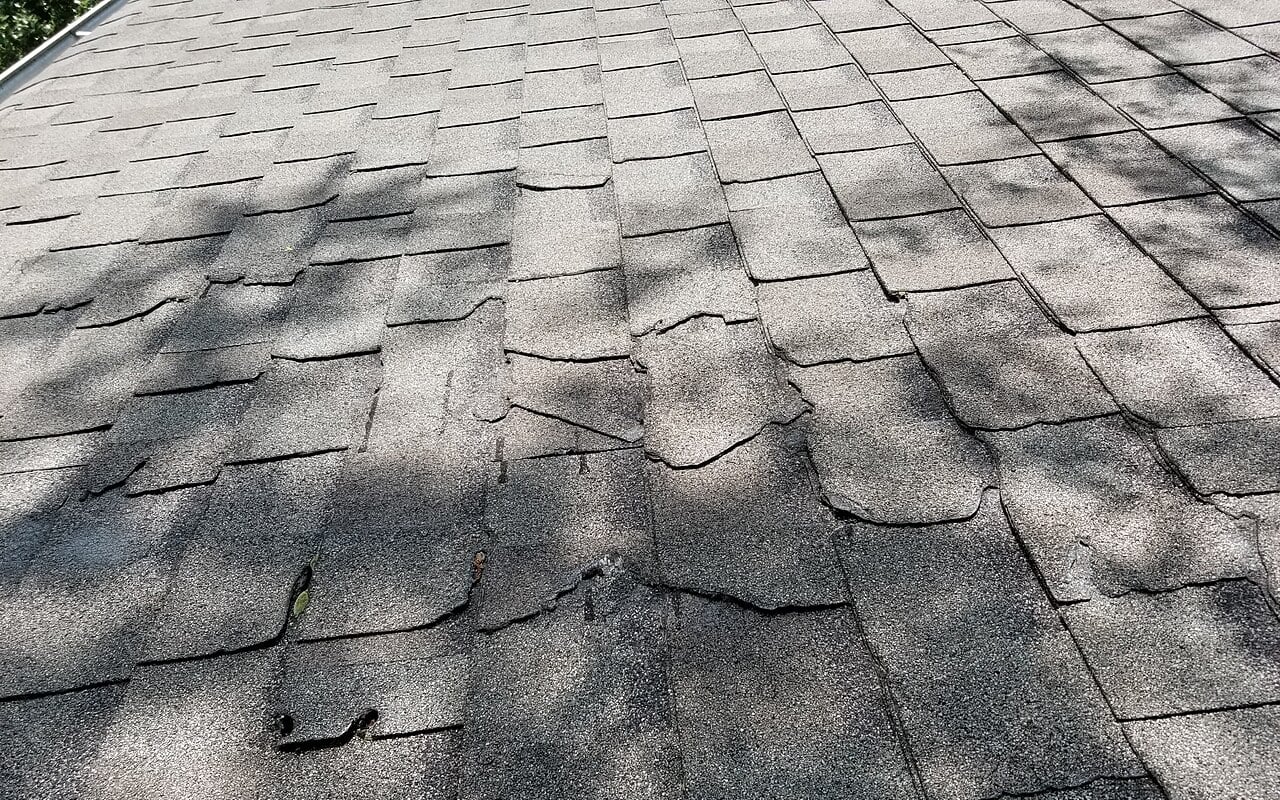
Cupping is the earlier stage. The edges of the shingle turn upward like a shallow bowl. From the ground, it looks like every shingle has a shadow underneath it. This happens when the asphalt dries out and shrinks faster than the fiberglass mat underneath. The shingle can’t lay flat anymore.
Clawing is more advanced. The edges stay down, but the center of the shingle lifts up, creating a hump. If cupping looks like a bowl, clawing looks like an arch. This means the shingle’s adhesive seal has broken completely. It’s one good wind gust away from peeling back or blowing off entirely.
Once curling starts - in either form - that shingle is never going back to flat. Water that would normally shed off the surface now has openings to get underneath. And wind that would skip over a flat roof now has edges to grab onto.
Curling on one or two shingles might be a manufacturing defect. Curling across an entire roof plane means the material is at the end of its service life. You’re buying months at best, not years.
2. You’ve got bald spots where granules used to be
Those rough, sand-like granules on your shingles aren’t decorative. They’re the roof’s sunscreen. They reflect UV radiation and slow down the asphalt’s natural aging process. When they’re gone, the underlying asphalt gets cooked by the sun, and it ages fast.
Here’s how to check without leaving your driveway:
- Look at your gutters. After a rain, check the downspout area or the ground below your gutters. If you see what looks like coarse black sand, that’s granule loss. A handful of granules in one spot means you’ve got a problem.
- Look at the roof surface. Sun-faded or darker patches on your shingles are areas where the granules have worn away. A healthy roof has uniform color. A balding roof looks patchy and uneven, like worn-out carpet.
- Check the bottom of your downspouts. Granules that wash off collect wherever water settles. If the splash block or drainage area has a pile of black grit, that roof is shedding its protection.
A brand-new roof doesn’t lose granules. A roof in its first 10 years sheds a tiny amount. A 15- to 20-year-old roof sheds them steadily. And a roof that’s balding in patches - that’s a roof telling you it’s done.
Safety note: Those granules are also your roof’s slip resistance. A smooth, granule-free roof is dangerously slick when wet. If you ever hire someone to walk your roof for an estimate, mention the granule loss so they come prepared with proper footwear and fall protection.
3. Cracks are running through the shingles
Thermal cycling does this. Every day your roof heats up in the sun and cools down at night. Over years, this expansion and contraction makes the asphalt brittle. Eventually it cracks.
There are two types:
- Surface cracks look like spiderwebs or alligator hide. They’re shallow and follow a random pattern. You’ll see them most on south- and west-facing slopes - the ones that get the most sun.
- Splits are deeper. They follow the shingle joints or the gaps between tabs. These go all the way through the asphalt layer to the fiberglass mat.
Surface cracks are a warning. Splits are an emergency. Both let water into the roof assembly.
Here’s the thing most homeowners miss: cracking isn’t always visible from the ground. It shows up more clearly in late afternoon when the low sun casts shadows across the roof surface. If you can, walk across the street and look at your roof when the sun is at a low angle. The cracks will jump out at you.
4. Your neighbors are replacing their roofs
This isn’t a technical sign, but it’s one of the most practical ones I know.
Houses in the same subdivision were usually built within a few years of each other, often by the same builder, using the same materials. If two or three of your neighbors have new roofs within the same year, yours is likely sitting on the same batch of shingles that just failed next door.
There’s also a practical upside to a neighborhood full of roofers. Material deliveries are already happening in your area, which sometimes means better pricing on shingles and disposal. The crews are already working nearby, so you might get a faster timeline. And if everyone else is replacing, your roof is almost certainly the same vintage and condition.
It’s not a diagnosis. But if you’re on the fence and three houses on your block just got new roofs, that’s a pretty strong hint from the universe.
5. You see moss or algae growing on the shingles
Let me separate these two because they’re not the same problem.
Algae (the black streaks you see on north-facing slopes) is largely cosmetic. The black stuff is Gloeocapsa magma, a bacteria that feeds on the limestone filler in asphalt shingles. It looks terrible, but it doesn’t structurally damage the shingle. If your only issue is black streaks, you can clean them or install zinc strips to prevent regrowth. You don’t need a new roof.
Moss is a different story. Moss holds moisture against the shingle surface like a wet sponge. In freeze-thaw climates (which covers most of the U.S. above the Mason-Dixon line), that moisture freezes and expands overnight, literally prying the granules off and lifting the shingle edges. Over time, moss roots work their way under the shingles and lift them further.
If you have moss in one small section near a tree line, you can clean it and address the shading issue. But if moss is thriving across multiple roof planes, your roof is staying wet longer than it should. That’s a sign of poor drainage, advanced granule loss, or both. And at that point, the moss isn’t the problem - it’s a symptom of a roof that can’t dry out fast enough.
6. Flashing is cracked, lifted, or missing
Flashing is the metal (or sometimes rubberized membrane) that seals every joint on your roof. Where the roof meets a wall. Around chimneys. In the valleys where two roof planes meet. At vent pipes and skylights. These are the most vulnerable spots on any roof, and flashing is their only defense.
Check around your chimney and plumbing vents. If the flashing is pulled away from the wall, rusted through, or visibly missing sections, water is getting in. The question is how much and how fast.
Here’s the judgment call: lifted or missing flashing on a roof that’s under 12 years old with healthy shingles is usually a repair job. A roofer can replace that flashing in a couple of hours for a few hundred dollars. But if the shingles around the flashing are also curling, cracked, or brittle, the flashing failure isn’t the root cause. Your roof system is aging out as a whole, and piecemeal repairs stop being cost-effective.
Safety note: Never try to reseal flashing yourself from a ladder. Flashing repairs require pulling up shingles, cleaning old sealant, and reinstalling - all work that involves roof penetration and ladder work at height. One wrong step on a drying roof is a trip to urgent care. This is a roofer’s job.
7. Your roofline is sagging
This is the sign that should make you pick up the phone immediately.
A sagging roofline means water has reached your roof deck - the plywood or OSB sheathing underneath the shingles. Once that wood gets wet repeatedly, it softens, loses structural integrity, and starts to bow under the weight of the roof above it.
You can see this from across the street. Stand far enough back that you can see the full ridgeline of your roof. It should be straight. If you see a dip, a wave, or a visible low spot between rafters, the decking underneath is compromised.
This is different from a roof that looks “wavy” because of uneven shingle installation. A sag is a structural issue. The decking has to be cut out and replaced in sections before new shingles go on. You’re not just paying for a roof replacement anymore - you’re paying for structural carpentry too.
If you see sagging, do not delay. A compromised roof deck can fail under snow load or even heavy rain. This is one of the few roofing issues that qualifies as a genuine emergency.
8. You can see daylight from inside the attic
Here’s the best diagnostic tool you already own: your attic.
Go up during the daytime. Turn off the attic lights. Let your eyes adjust for 30 seconds. Now look up at the roof sheathing.
If you see daylight coming through, water can come through the same holes.
A few pinpricks of light around a chimney or plumbing vent are normal - those penetrations are sealed from the outside. But if you see light streaming through the field of the roof - the flat areas between the rafters - that means gaps in the decking, missing shingles, or both.
While you’re up there, look for:
- Dark stains on the wood. Water stains on the underside of the decking mean water has been getting in and sitting there.
- Wet or compressed insulation. If your attic insulation looks flattened, discolored, or feels damp, it’s been wet and has lost its R-value.
- Mold or mildew smell. That musty attic odor is moisture that’s been trapped long enough for mold to start growing.
This is a hard-stop sign. If you see daylight or water stains in multiple areas, don’t wait for a leak to show up in your living room. The damage is already happening inside your roof assembly.
Safety note: When you go into your attic, stay on the joists. Do not step between them - that’s how you go through your ceiling. Bring a flashlight even if it’s daytime, wear a mask if you see any signs of mold, and never go into an attic alone.
9. Your energy bills have climbed with no other explanation
A failing roof loses insulating value. It’s not that the shingles themselves insulate - they don’t. But when the roof assembly is compromised, several things happen that force your HVAC to work harder:
- Wet insulation doesn’t insulate. Fiberglass and cellulose lose their R-value when they get damp. A soaked batt of insulation performs about as well as a wet towel.
- Gaps in the decking let conditioned air escape. In winter, warm air leaks out through the roof. In summer, hot attic air pushes down into your living spaces.
- Poor ventilation gets worse. An aging roof often comes with blocked or deteriorated soffit vents, ridge vents, or gable vents. Without proper ventilation, your attic becomes a heat trap or a moisture trap depending on the season.
If you’ve ruled out windows, doors, and thermostat changes, and your energy bills are still climbing 15-20% year over year, the roof may be the culprit. Check your attic temperature on a summer afternoon. If it’s 140°F when it’s 95°F outside, your roof system isn’t doing its job.
10. Your gutters are pulling away from the fascia
Gutters that sag, separate from the house, or hang at an angle aren’t just a gutter problem. They’re a fascia problem.
The fascia board is the trim that runs along the edge of your roof. Gutters attach to it. If the fascia is rotting (usually from water running behind the gutters or from ice damming), it can’t hold the gutter screws anymore. The gutters start to pull away, which makes the problem worse - now water spills behind the gutters instead of into them, accelerating the rot.
That water behind the gutters is coming from your roof edge. It means your drip edge flashing is failing, your shingles aren’t extending far enough past the fascia, or your gutters have been clogged and overflowing long enough to damage the wood behind them.
Here’s why this matters for your roof decision: if the fascia is rotting, it’s likely that the decking along the eaves is rotting too. That’s the same plywood or OSB that supports the first few feet of your roof. A roof replacement on a house with rotted fascia usually means replacing eaves decking and fascia board as part of the job. Budget for it.
11. The roof is past its 20th birthday
Age alone isn’t a failure. I’ve seen 25-year-old roofs that still had life left (usually on well-ventilated homes in mild climates). But age is a sign of diminishing returns.
Most asphalt shingle roofs last 18-25 years. At year 20, you’re in the zone where every repair is a bet against probability. Even if your shingles look decent, the rest of the system - underlayment, flashing, decking, ventilation - is two decades old and has been baking in your attic for all those years.
Here’s what I tell homeowners: a 20-year-old roof that looks perfect from the ground is still sitting on an aging support system. The underlayment (the waterproof layer between shingles and decking) may be brittle and cracked even if the shingles aren’t. The seals around vents and chimneys may have dried out. The flashing may be nearing the end of its service life even if it isn’t visibly failing yet.
If your roof is 20+ years old and showing any other sign on this list, it’s time to seriously plan for replacement. Don’t let the “it still looks okay from the ground” mentality cost you a new ceiling.
How many signs before you replace?
Here’s a simple framework I give homeowners:
| Number of signs | Recommended action |
|---|---|
| 1-2 | Schedule a professional inspection; patch if appropriate |
| 3-4 | Plan for replacement within 1-2 years; start budgeting now |
| 5+ | Schedule replacement estimates; repairs are throwing money away |
This is a rough guide, not a hard rule. A roof with one sign - say, a sagging roofline - is an emergency. A roof with three signs plus an active leak needs action in weeks, not years. Use your judgment, but when in doubt, get a professional to look at it. An inspection costs $150-$300, and it’s the best money you’ll spend on your roof.
When repair still makes sense
Not every roof with a few signs needs replacement. There are a few situations where repair is the smarter call:
- The damage is isolated. One section of wind-lifted shingles over sound decking is patchable.
- Your roof is under 12 years old. If a 10-year-old roof has one problem area, a repair captures the remaining life you’d waste by replacing early.
- You’re selling within two years. A targeted repair can get you through inspection without a $15,000 replacement. Disclose the age honestly to buyers.
- You need more time to save. A tarp and strategic patching can buy 6-12 months while you line up financing. Just don’t use the delay as an excuse to ignore the problem - set a date and stick to it.
The bottom line
Your roof sends signals before it sends water into your living room. Most homeowners can spot the early signs from the ground with a pair of binoculars and fifteen minutes. The question isn’t whether you’ll replace your roof - every roof gets replaced eventually. The question is whether you control the timing, or the roof controls it for you.
Replacing on your own schedule costs less. Contractors charge a premium for emergency work. You have time to compare estimates, choose materials thoughtfully, and avoid the collateral damage (drywall, flooring, electrical) that comes with waiting until a leak forces your hand.
If you’re weighing whether to repair or replace, see our guide on roof repair vs replacement for a detailed decision framework.
Related roofing guides
Use these next if you want to move from spotting symptoms to making a plan:
- Start with a full roof inspection checklist if you want a room-by-room and exterior walkthrough.
- Read what a roof inspection includes before you pay for a professional inspection.
- Compare these warning signs with the broader signs of roof damage guide if storm damage may be involved.
- If water has already shown up inside, use the roof leak signs guide to narrow down likely entry points.
- For budgeting, check the roof leak repair cost guide before assuming replacement is your only option.
- If the roof is aging but not failing yet, the complete roof maintenance guide explains what still buys time.
- Use how often to inspect your roof to set a simple spring and fall checkup schedule.
- If you are trying to delay replacement safely, read how to extend roof lifespan.
- Material age matters too, so compare this article against roof lifespan by material.
- When replacement is the likely path, the homeowner’s guide to roof replacement walks through the full decision.
- Timing affects scheduling and weather risk, which is why the best time of year to replace a roof guide is worth reading early.
- Before signing anything, review how to choose a roofing contractor and the questions to ask a roofer.
- Once you hire, the new roof installation process and day-by-day roof replacement timeline explain what happens next.
Frequently asked questions
How often should I check my roof for these signs?
Twice a year: once in spring after the last freeze and once in fall before winter sets in. Add a check after any major wind, hail, or storm event. If you live in an area with heavy tree cover, add a third check in late summer when leaves start falling.
Can I inspect my roof myself, or should I hire someone?
Ground-level inspection is safe and useful - that’s where you’ll spot curling, missing shingles, sagging rooflines, and granule loss. Attic inspections are also safe if you stay on the joists. But for close-up shingle examination or anything requiring roof access, hire a licensed contractor. A professional inspection costs $150-$300 and covers code violations, ventilation issues, and subtle damage you won’t catch from the ground.
Does homeowners insurance cover roof replacement?
Only for sudden, accidental damage caused by a covered peril - wind, hail, falling trees, fire, or similar events. Normal wear and tear, age-related deterioration, and gradual granule loss are not covered. If you suspect storm damage, file a claim and get a professional inspection before the insurance adjuster arrives. Having documented evidence strengthens your claim significantly.
How much does a full roof replacement cost?
In 2026, most U.S. homeowners pay between $7,000 and $14,000 for a standard asphalt shingle roof replacement. The biggest factor is roof size - a 1,500-square-foot roof costs roughly half what a 3,000-square-foot roof costs. Pitch, complexity, and regional labor rates also affect pricing.
What if I only see one or two signs?
Address them. A single leak is still an active leak. But one or two isolated issues on a relatively young roof (under 12 years old) usually point to a targeted repair rather than a full replacement. Have a professional inspect the area to confirm there’s no underlying damage to the decking, underlayment, or flashing before you decide.
Is it safe to walk on my roof to inspect it?
No. I strongly advise against walking on your roof unless you have proper fall protection, roofing experience, and the right footwear. Roofs are steep, slick surfaces - especially if granules have worn away. Falls from roofs account for thousands of ER visits every year. All the signs listed below can be spotted from the ground with binoculars or from inside your attic. If you need a close-up inspection, hire a licensed contractor with insurance.
Can a new roof be installed over my existing shingles?
Some contractors offer roof overlays (installing new shingles over old ones), but I generally don’t recommend them. Overlays hide underlying damage to the decking and underlayment, add extra weight your roof structure wasn’t designed for, and typically void the warranty on new shingles. A full tear-off and replacement gives you a clean inspection of the decking, new underlayment, and the full manufacturer warranty. The extra cost is worth the peace of mind.